
Introduction:
For existing claimants, some of these changes may mean they will no longer meet the more restricted eligibility criteria, so they will have to adjust to a change in income or monthly benefit payments.
Key Changes:
Benefit
|
Change
|
Government’s estimated impact
|
| Universal Credit |
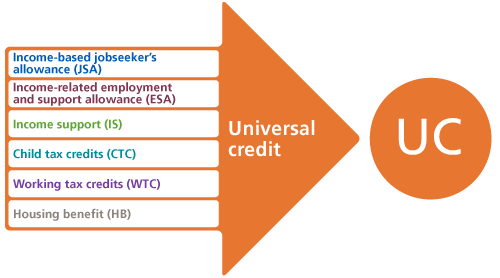
This new benefit will replace all means tested benefits and tax credits.
All existing working age benefits (such as Jobseekers Allowance, Income
Support and Working Tax Credit) will be subsumed within one monthly household
payment of Universal Credit. It'll be paid to people both in and out of work.
A new tougher sanctions regime will also be introduced, tying claimants more
closely to labour market activity. Couples made up of pensioners and someone
of working age will be treated as a working age household instead of a
pensioner household. This could mean losses in excess of £100 per week for
some. April 2013: Universal Credit ‘Pathfinder’ programme trials take place in Tameside, Oldham, Wigan and Warrington. October 2013: Universal Credit goes live nationally April 2014: all new claims will be for Universal Credit. October 2017: all old claims transferred to Universal Credit. |
5.9 million households will have a change
in household entitlement as a result of Universal Credit (3.1 million will
have a higher entitlement and 2.8 million a lower entitlement).
|
| Housing Benefit |
A number of changes are being introduced in order to save £2 billion from
this budget by 2014. Changes in the way Housing Benefit rates are set will
mean that fewer properties will be available to rent within the rates
available. April 2013: Housing Benefit size criteria introduced for new and existing working age Housing Benefit claimants. |
An estimated 660,000 Housing Benefit
claimants living in social rented accommodation will be considered to be
living in homes too big for their needs.
|
| Personal Independence
Payment |
Disability living allowance will be replaced by a new personal
independence Payment (PIP) and the budget for this benefit will be cut by 20
per cent from its current level. Entitlement will be based on a new
face-to-face medical assessment. Around one in six current DLA claimants will
not qualify for PIP. April 2013: PIP introduced in a number of areas for eligible working age people aged 16 to 64. During this period new claimants in all other parts of the country will continue to claim DLA. June 2013: new PIP claims are taken from all parts of the country. October 2013: existing DLA claims reassessed for PIP. Between October 2013 and March 2016. |
500,000 expected to lose benefits by
2015/16.
|
| Employment and Support Allowance (ESA) |
Contribution-based ESA will be time limited to just one year (retrospective change to 365 day before claim) with more stringent qualifying assessments. April 2013: time limited ESA introduced and absorbed into Universal credit in October 2013. |
An estimated 700,000 contributory ESA
claimants in the Work Related Activity Group will be affected by time
limiting by 2015/16.
|
| Benefit cap |
The cap aims to ensure that no one will receive more money out of work
that the level of average wages (currently set at £500 a week for a family
and £350 for a single person). The implication is that a family can receive
more when out of work than in work, which is simply not the case. The few
families who do receive more than £500 when out of work would also receive
that level of benefits on top of their wages when in work. April 2013: benefit cap introduced |
114,000 households will
have their benefits reduced by this policy by 2014/15.
|
| Localised council tax support |
Council Tax Benefit will be replaced by localised schemes. The current
budget (less 10 per cent) will be given to local authorities who can decide
how their local scheme will operate. Only pensioner households are protected
which means that working age households who currently get full help are
likely to have to pay at least 20 per cent of their bills from 2013. April 2013: localised council tax support schemes administered by local authorities. |
Not applicable.
|
| Localised welfare assistance |
Social fund – some aspects are being abolished with budgets devolved to
local authorities without any requirement to provide any specific support. April 2013: localised welfare assistance schemes administered by local authorities in England and the devolved administrations in Wales. |
In 2009/10 there were over 3.6 million
crisis loan applications
|
